Depth:
Northern Depth: 170 - 620 meters
Trench Depth: 100 - 675 meters
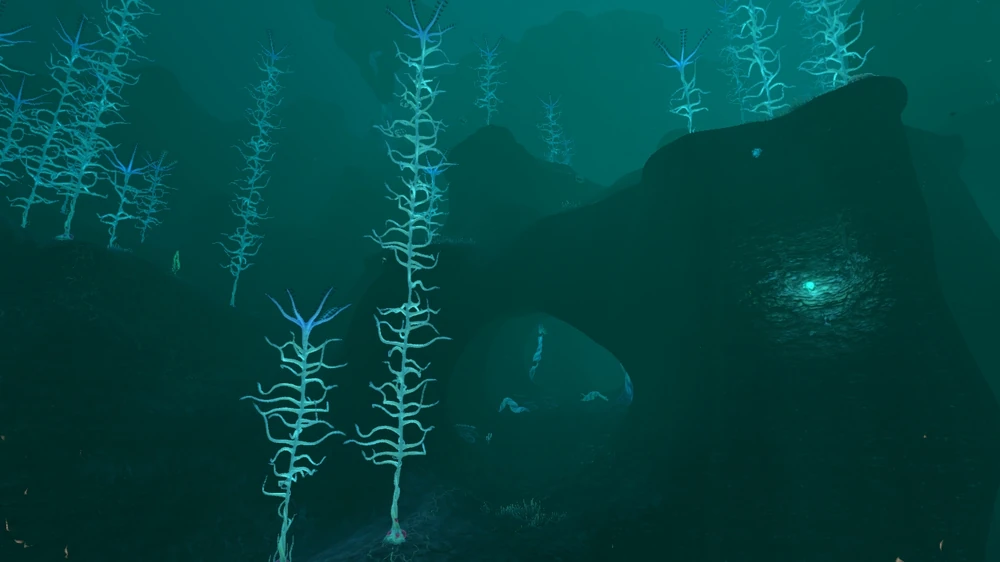
The Blood Kelp Zones are biomes in Subnautica characterized by their depth, darkness, and abundance of giant Bloodvines, some of which carry Blood Oil pustules at the base of their stems. There are two Blood Kelp Zones in the game, being the Northern Blood Kelp Zone, and the Blood Kelp Trench.
The Northern Blood Kelp Zone can be found to the north of Lifepod 5, in-between the Northwestern Mushroom Forest, Underwater Islands, Mountains and Dunes. This zone is considerably larger than the Trench, albeit being more exposed to the surface and not as deep. It features a cavern system located below the Bloodvines where their roots can be found. Unique to the Northern Blood Kelp Zone are Crabsquids and a single adult Ghost Leviathan, as well as small "underwater islands" supported by Ancient Floaters and Bloodroots. This biome is littered with Quartz. There are Salt Deposits and Gel Sacks around some of the bushes.
The Blood Kelp Trench is located south-west from Lifepod 5, between the Dunes, the Sparse Reef, the Grassy Plateaus and the Sea Treader's Path. The Trench lacks the Crabsquids and the Ghost Leviathan of the Northern Blood Kelp Zone, but still has predators in the form of Blighters, Ampeels, and Warpers. The more confined spaces may make it more difficult to avoid them if one is not careful. It consists of a single deep trench with natural rock bridges spanning from one wall to another, and a small cavern system located below the Bloodvines where their roots can be found. One of the Wrecks can be found in this area, stuck between the trench's walls. This zone is considered unsuitable to explore with the Cyclops due to the trench's narrow width, and an ill-equipped Prawn Suit may get stuck due to this biome's sheer depth. Gel Sacks can only be found in the deepest area of this biome, below 500 meters, in the section below the wreck. Ampeel Eggs can be found at the very bottom of the trench.
Depth: 40-200 meters
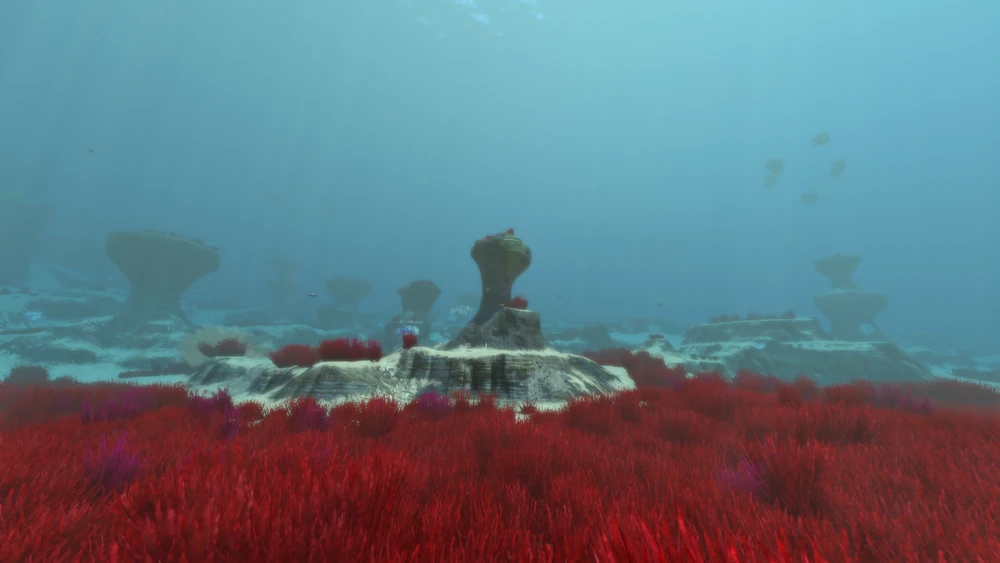
The Grassy Plateaus are characterized by large, pillar-like structures seemingly formed by subaquatic hydraulic action or abrasion (erosion), smooth marine plains, and sandy terrain almost completely carpeted with Blood Grass, giving the Grassy Plateaus their distinctive name. There are 4 Grassy Plateau areas in Subnautica, and they have borders with the Kelp Forest, Mushroom Forest, Safe Shallows, Sparse Reef, Blood Kelp Trench, Crag Field, Crash Zone, Underwater Islands, and the Dunes. While exploring the Grassy Plateaus, it is advised for new players to pay attention to their surroundings for groups of Biters and to stay far away from suspicious sand clouds, as Sand Sharks dwell abundantly in this biome. Tiger Plants, another hazard, can also be found here, most commonly beneath Wrecks and in crevices. Besides the large abundance of resources such as Quartz, Limestone and Sandstone outcrops, this biome also features several small caverns, as well as entrances to the Jellyshroom Cave. This biome contains numerous wrecks that include useful Fragments for technology
Depth: 0-160 meters
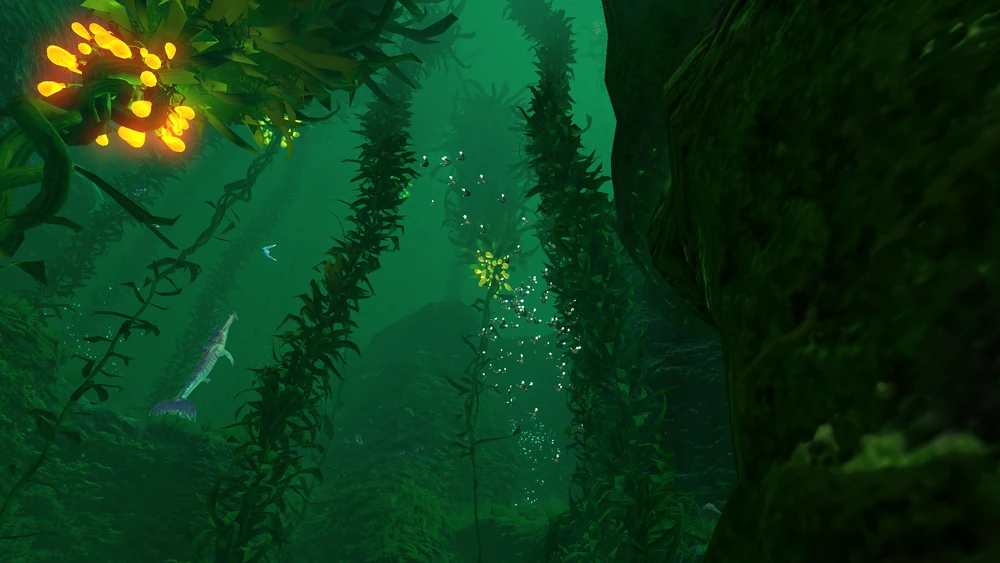
The Kelp Forests biomes are characterized by the abundance of Creepvines, and possess a distinct greenish hue in the water.They are located at medium-shallow depths, and are home to mostly passive life forms, with the only exceptions being Stalkers and Drooping Stingers. The seabeds are mostly mossy and sandy, with the terrain being comprised of grassy knolls and arches, which sometimes show entrances to small cave systems. There are also many canyons to be found in these forests. There is a lot of decorative flora on the sandy, grassy seabed.
Depth: 525 - 1065 meters
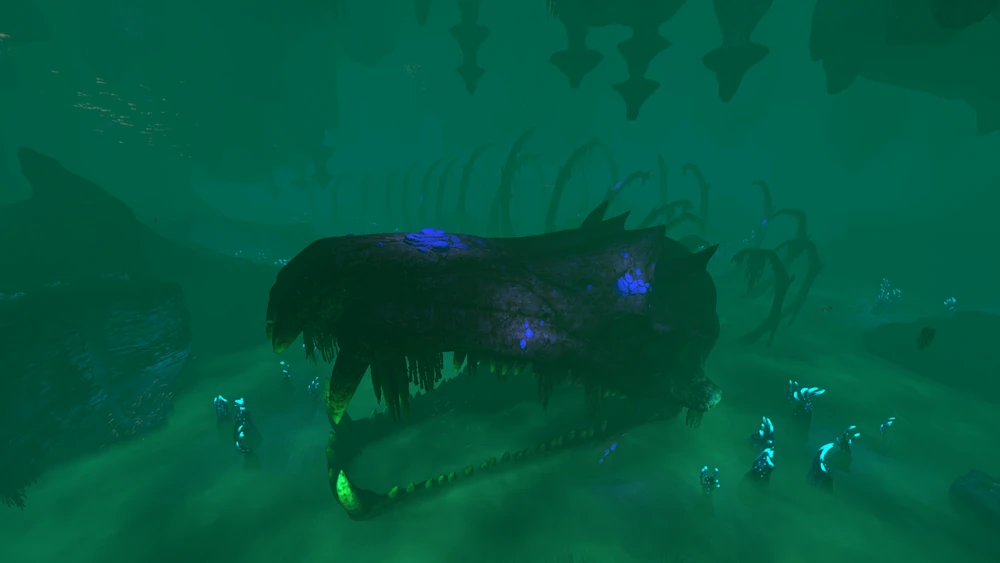
The Lost River is a massive, frigid cave biome located deep under the surface and is further divided into seven distinct sub-biomes. It can be accessed through four entrances found in the Northern Blood Kelp Zone, the Deep Grand Reef, the border between the Mountains and the Bulb Zone, and the Blood Kelp Trench. While the Cyclops and Prawn Suit are fully capable of exploring the entirety of the Lost River and the Inactive Lava Zone beyond it, there are some sections that are too deep for the Seamoth to explore, even with its strongest depth module.
The water in The Lost River possesses a distinct, gloomy, greenish tint due to the illuminating brine pools that cover a majority of the seabed. These pools are highly acidic, even to the Seamoth, and will damage the player if entered without the increased protection of the Prawn Suit. Wildlife in this area have become accustomed to the brine, meaning they can swim and grow in the pools without issue. Skeletons of immense, long-deceased fauna are a common sight in the Lost River, which, in conjunction with the biome's many native, spectral fauna, give the Lost River a uniquely eerie atmosphere. The Lost River is one of the coldest biomes, with temperatures on the sea floor rarely rising above 10 degrees Celsius. Hence, thermal reactor modules do not work very well here, unless the vehicle is positioned near a thermal vent.
Depth: 0-80 meters
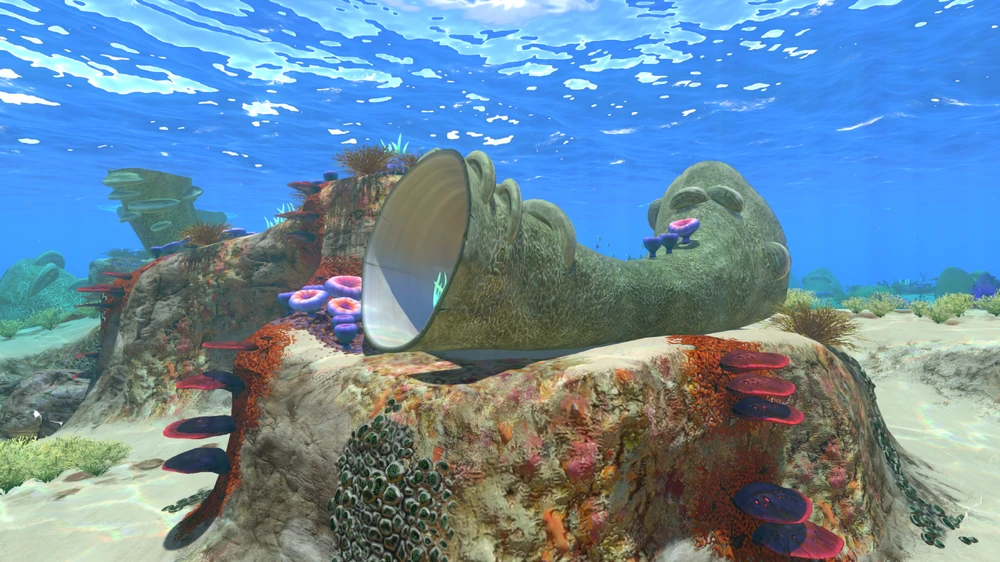
The Safe Shallows is the first biome encountered by the player, as it is where Lifepod 5 crashed. This is also the starting point of the game, mainly located near the center of the map. The biome has multiple sections that are not directly connected to each other, but all these fragments of the biome have the same general look.
The Safe Shallows contains coral reefs sprawling over a large part of the area, with small cave systems that can be found beneath the surface. This biome is one of the safest in the game, as it is a relatively shallow area, there are few environmental hazards, and no predators call this biome home. However, caution should still be used for the occasional Gasopods passing through, and the caves are home to hostile Crashfish. Some predators are also known to wander here from adjacent biomes, mainly Stalkers from the Kelp Forests, and Sand Sharks from the Grassy Plateaus. The Safe Shallows offers plentiful diving experiences for all players, especially newcomers, as it is home to a variety of life forms; coral, fauna (mostly edible), and flora alike, with a great abundance of harvestable materials. It is one of the most colorful biomes in the game.